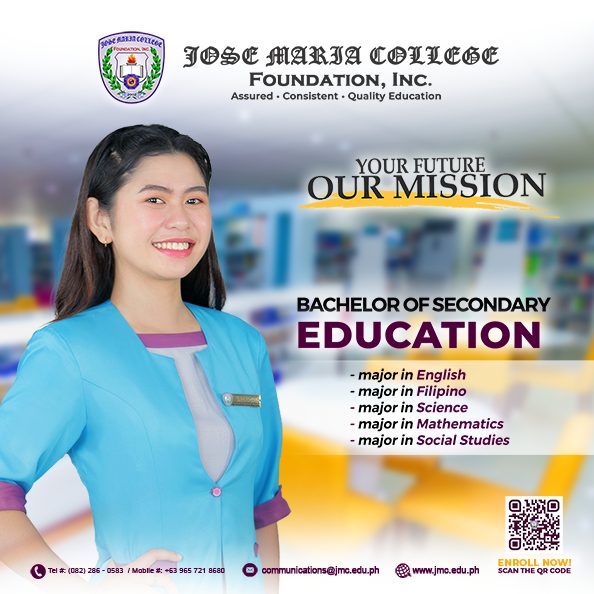
Bachelor of Secondary Education
- Major In English
- Major In Mathematics
- Major In Filipino
- Major In Science
- Major In Social Studies
The Bachelor of Secondary Education program plays a crucial role in shaping the next generation of teachers who will inspire, educate, and mentor students during their formative years, contributing significantly to the development of a well-rounded and educated society.
- 4 Years / Onsite
- Intakes: June -> DEcember, January -> April
Overview
The Bachelor of Secondary Education (BSEd) program is an undergraduate degree that focuses on preparing students to become qualified and competent secondary school teachers. It is designed to equip aspiring educators with the necessary knowledge, skills, and competencies to teach students in grades 7 to 12.
Career Opportunities
BSED graduates have a wide range of career opportunities, primarily centered around the field of education. Here are some of the career paths that BSED graduates can pursue:
Secondary School Teacher: The most common and direct career path for BSED graduates is to become a secondary school teacher. They can teach their specialized subject (e.g., English, Mathematics, Science, Social Studies, etc.) to students in grades 7 to 12 or equivalent levels, depending on the country’s educational system.
Middle School Teacher: In some educational systems, secondary education includes middle school grades, such as 6th to 8th grades. BSED graduates can teach in middle schools if the education system has this level included in secondary education.
Private Tutoring: BSED graduates can offer private tutoring services to individuals or small groups of students, providing additional academic support and personalized instruction in their specialized subject.
Curriculum Developer/Instructional Designer: Graduates can work in educational publishing companies, schools, or government agencies as curriculum developers or instructional designers. They design educational materials, textbooks, and instructional resources to enhance the learning experience of students.
Education Consultant: BSED graduates can become education consultants, providing expertise and guidance to schools, educational institutions, or organizations on matters related to curriculum development, teaching methodologies, and educational policies.
Education Administrator: With additional experience or higher education, BSED graduates can move into educational administration roles, such as school principals, vice principals, or department heads, where they oversee school operations and staff.
Education Researcher: BSED graduates with a passion for research can work as educational researchers, conducting studies and investigations to improve teaching methodologies, student learning outcomes, and educational policies.
Educational Technology Specialist: Graduates with a strong understanding of educational technology can work as technology specialists in schools, helping to integrate technology into the classroom and support teachers in using digital tools effectively.
Special Education Teacher: BSED graduates can pursue additional training or certifications to become special education teachers, providing support and tailored instruction to students with diverse learning needs.
Education Program Coordinator: In non-profit organizations or government agencies, BSED graduates can work as program coordinators, developing and implementing educational programs to address specific educational needs or social issues.
Education Writer/Blogger: BSED graduates with excellent writing skills can pursue careers as education writers or bloggers, contributing to educational publications, websites, or creating educational content online.
Agencies and institutions that employ
BSEd graduates are sought after by various agencies and institutions within the education sector and related fields. Here are some of the agencies and institutions that commonly employ BSEd graduates:
Public and Private Schools: Elementary, middle, and high schools hire BSEd graduates as teachers for various subjects, depending on their specialization. These schools are the primary employers for BSEd graduates, where they can teach students in grades 7 to 12.
International Schools: BSEd graduates with subject expertise and language proficiency may find opportunities to teach in international schools that cater to expatriate and international students.
Colleges and Universities: Some BSEd graduates with additional education or experience pursue careers in higher education institutions as professors, instructors, or academic advisors in education departments or teacher training programs.
Educational Publishing Companies: Companies that create educational materials, textbooks, and digital resources often employ BSEd graduates as curriculum developers, instructional designers, editors, and content creators.
Government Education Departments: BSEd graduates can work for government agencies responsible for education policy, curriculum development, teacher training, and educational program implementation.
Non-Governmental Organizations (NGOs): NGOs that focus on educational development and advocacy often hire BSEd graduates to work on projects related to improving access to quality education, teacher training, and educational research.
Education Consultancies: BSEd graduates can work for consultancies that provide education-related services, including curriculum development, teacher training, and educational technology integration.
Educational Technology Companies: Companies that develop educational software, learning management systems, and other educational technology solutions may employ BSEd graduates as instructional designers, content creators, or education specialists.
Private Tutoring Centers: BSEd graduates can find employment in private tutoring centers that offer academic support and enrichment programs for students.
Museums and Educational Centers: Some museums and educational centers hire BSEd graduates to develop educational programs, lead workshops, and facilitate interactive learning experiences for visitors, especially in areas like history, science, or art.
Educational Assessment Organizations: BSEd graduates may work for organizations that develop and administer standardized tests and assessments used in schools and educational institutions.
Education Research Institutes: Research institutions and think tanks focused on education hire BSEd graduates to conduct research on educational policies, teaching methodologies, and student learning outcomes.
Learning Outcomes
Learning outcomes for the Bachelor of Secondary Education (BSEd) program are the specific knowledge, skills, and competencies that students are expected to achieve by the end of their undergraduate education. These learning outcomes are designed to prepare graduates to become effective and competent secondary school teachers. While specific learning outcomes may vary depending on the institution and specialization, here are some common learning outcomes for BSEd graduates:
Subject Matter Knowledge: Demonstrate a deep understanding of the content and concepts within their chosen subject specialization, whether it is English, Mathematics, Science, Social Studies, or other subjects.
Pedagogical Knowledge: Develop expertise in various teaching methodologies, strategies, and techniques to effectively convey subject matter to secondary school students with diverse learning styles and abilities.
Classroom Management: Acquire skills in classroom management and discipline to create a positive and conducive learning environment that fosters student engagement and participation.
Curriculum Development: Design and develop effective lesson plans and educational materials aligned with national or state standards and learning objectives, incorporating innovative teaching approaches and technology.
Educational Psychology: Understand the principles of educational psychology and apply them to address the cognitive, emotional, and social needs of students in a secondary school setting.
Assessment and Evaluation: Design appropriate assessment methods to evaluate student progress and learning outcomes, and use assessment data to inform instructional decisions and support student growth.
Educational Technology Integration: Incorporate educational technology tools and resources into teaching practices to enhance student learning and engagement.
Differentiated Instruction: Implement differentiated instruction techniques to cater to the diverse learning needs of students, including those with varying abilities and cultural backgrounds.
Ethical and Professional Conduct: Demonstrate ethical conduct, professionalism, and sensitivity to cultural diversity while maintaining confidentiality and respecting students’ rights.
Classroom Inclusion and Special Education: Understand the principles of inclusive education and be prepared to accommodate and support students with special educational needs within the mainstream classroom.
Collaboration and Communication: Develop effective communication skills to collaborate with students, colleagues, parents, and the wider school community, fostering positive relationships and enhancing the learning environment.
Reflective Practice: Engage in reflective practice, critically evaluating teaching methods and strategies to continually improve instructional effectiveness and student learning outcomes.
Education Research: Demonstrate an understanding of basic educational research principles and the ability to critically analyze and apply educational research findings to inform teaching practices.
Lifelong Learning: Cultivate a commitment to lifelong learning and professional development, staying updated with educational trends and advancements throughout their teaching career.
Curriculum
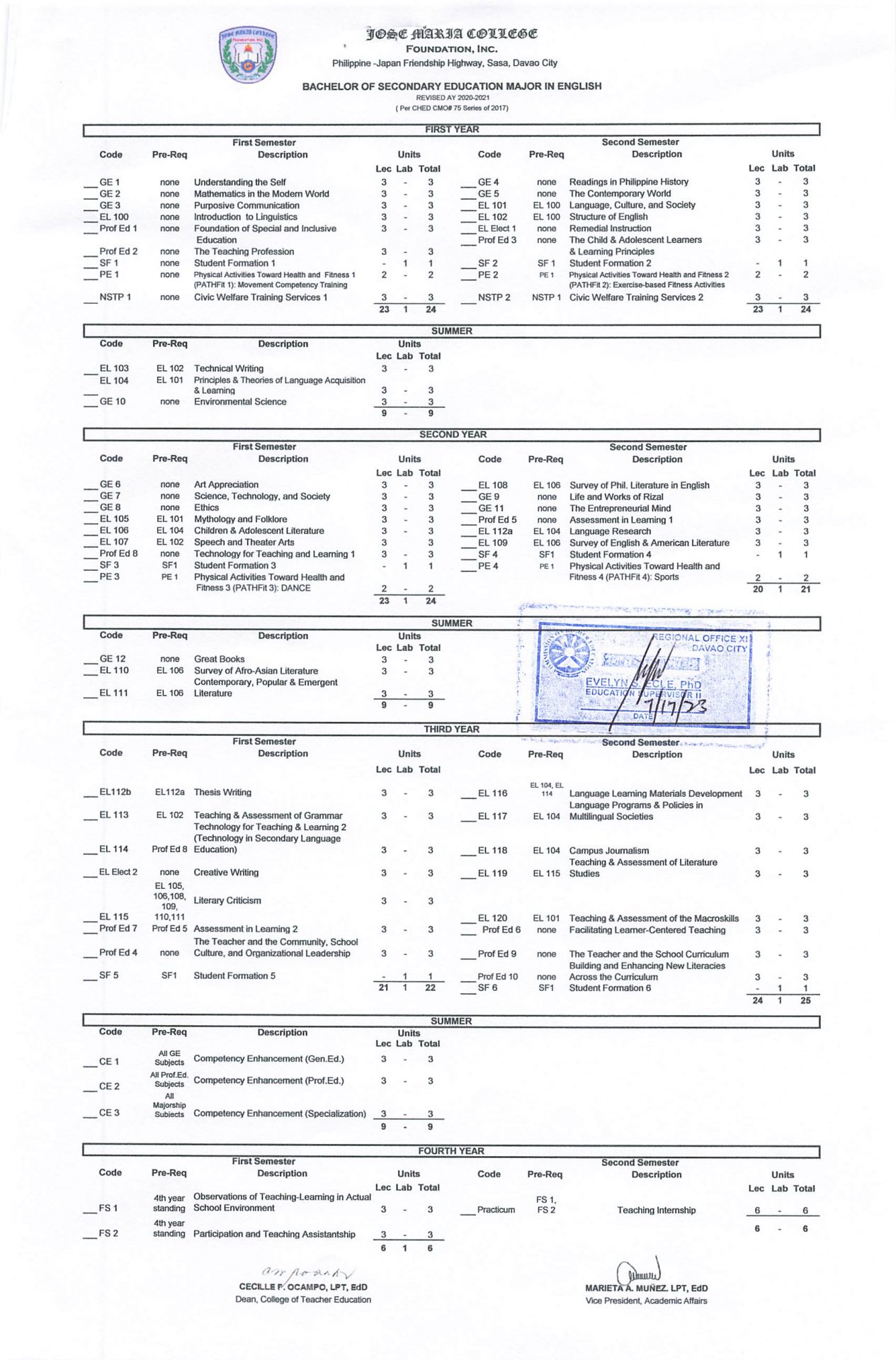
Bachelor of Secondary Education major in English
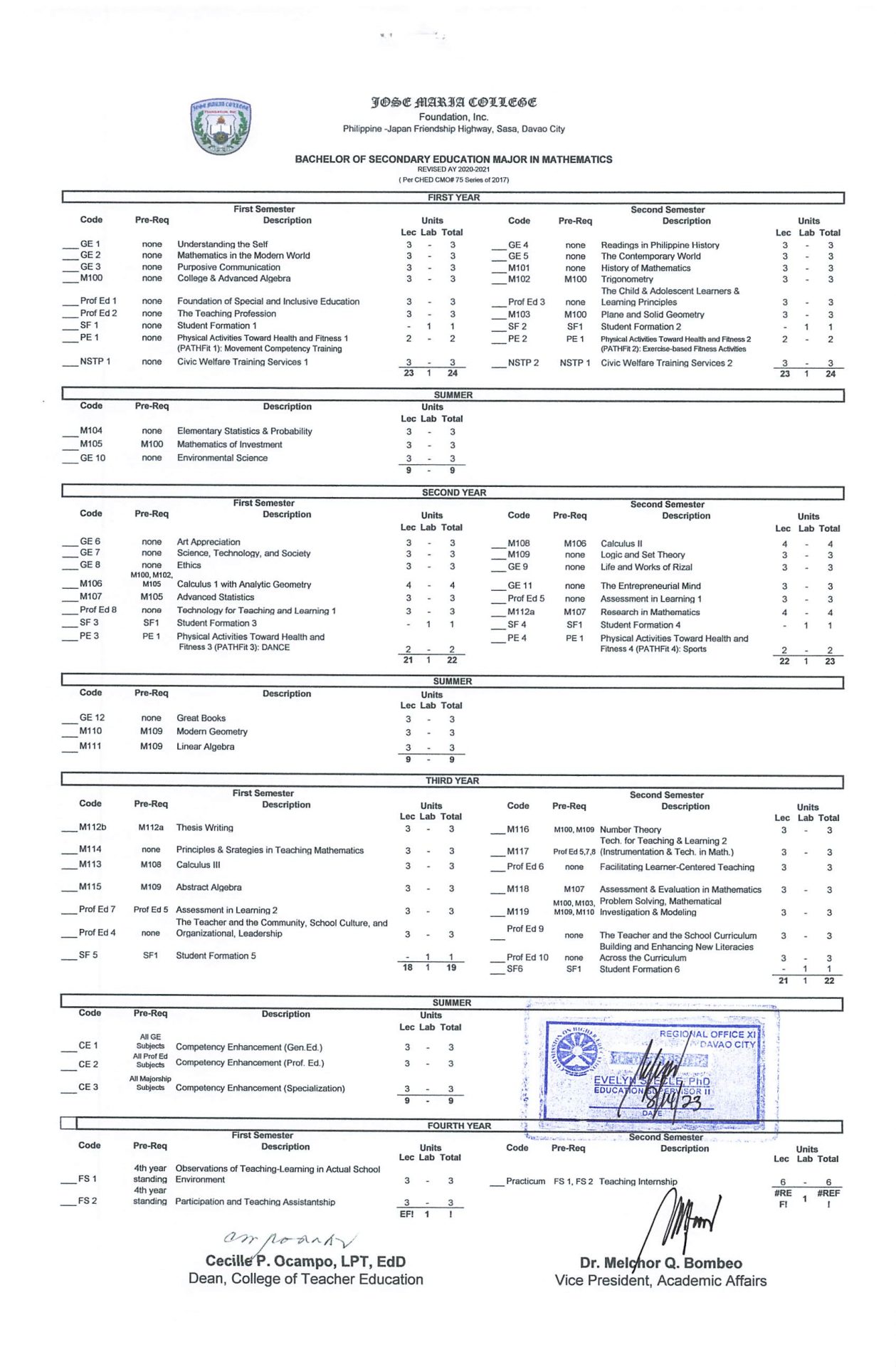
Bachelor of Secondary Education major in Mathematics
Bachelor of Secondary Education major in Filipino
Bachelor of Secondary Education major in Science
Bachelor of Secondary Education major in Social Study
Contact us
KJC Compound, Brgy. Sasa. Catitipan Davao City
For reference, the official contact channels that may be used are:
Email: co************@*****du.ph
Facebook: fb.com/josemariacollege

Vision
A global center of excellence for Teacher Education
Mission
Produce educators who are globally competent in knowledge and skills; visionaries at the forefronts of service imbued with deep commitment to holistic human development.
Goals
- Equip future teachers with knowledge and skills required to qualify them for the various functions and roles involved in the teaching profession;
- Provide a well-planned, relevant, and outcome-based curriculum vis à-vis the guidelines set by the Commission of Higher Education.
- Give opportunities for exposure to areas of instruction, research, and extension relevant to the teaching profession;
- Immerse student-teachers in different teaching-learning environments in actual classroom settings both in private and public schools which they can apply learned pedagogy into practice; and
- Adhere to all the domains stipulated in the Philippine Professional Standards for Teachers (PPST) to acquire minimum qualifications necessary for the teaching profession.
Graduate Attributes
- Field Expertise In-depth knowledge and conceptual mastery in chosen field of study, enabling analysis and application of theories and models
- Communication proficiency Ability to clearly convey complex ideas and perspectives in written, verbal and visual modes to diverse audiences
- Critical thinking and problem-solving Capacity to deeply analyze issues, weigh evidence, evaluate solutions, and apply strategic and systemic thinking to decision making
- Global citizenship Social consciousness regarding pressing issues combined with inclusive mindsets valuing diversity and community well-being
- Adaptability and resilience Flexibility to embrace change; Self-motivation and perseverance to overcome challenges and stressors
- Integrity and ethics Guided by principles, justice, and honesty with a profound sense of purpose and responsibility.
PROGRAM EDUCATIONAL OBJECTIVE
5 years after graduation, the Teacher Education graduates will be able to:
- be equipped with the skills and knowledge to create inclusive learning environments that cater to the diverse needs of students, promoting active engagement and participation;
- demonstrate a commitment to continuous learning and self-improvement, actively engage in ongoing professional development opportunities to enhance their teaching skills and adapt to evolving educational settings;
- be proficient in utilizing technology and innovative teaching approaches to effectively engage students and navigate challenges in modern learning environments, promote digital literacy and meaningful interpersonal connections;
- uphold ethical standards and demonstrate integrity in all interactions with students and colleagues, cultivate compassionate and empathetic approaches to teaching and learning;
- prioritize the holistic development and well-being of their students, recognize the significance of emotional well-being and mental health in academic success, and integrate counseling and support into their teaching practices.
PROGRAM LEARNING OUTCOMES
Bachelor of Secondary Education major in English
- Possess broad knowledge of language and literature for effective learning;
- Use English as a glocal language in a multilingual context as it applies to the teaching of language and literature;
- Acquire extensive reading background in language, literature, and allied fields;
- Demonstrate proficiency in oral and written communication;
- Show competence in employing innovative language and literature teaching approaches, methodologies, and strategies;
- Use technology in facilitating language learning and teaching;
- Inspire students and colleagues to lead relevant and transformative changes to improve learning and teaching language and literature; and
- Display skills and abilities to be a reflective and research-oriented language and literature teacher.
- Demonstrate a variety of thinking skills in planning, monitoring, assessing, and reporting learning processes and outcomes;
- Practice professional and ethical teaching standards sensitive to the local, national, and global realities; and
- Pursue lifelong learning for personal and professional growth through varied experiential and field-based opportunities
Bachelor of Secondary Education major in Mathematics
- Exhibit competence in mathematical concepts and procedures;
- Exhibit proficiency in relating mathematics to other curricular areas;
- Manifest meaningful and comprehensive pedagogical content knowledge (PCK) of mathematics;
- Demonstrate competence in designing, constructing, and utilizing different forms of assessment in mathematics;
- Demonstrate proficiency in problem-solving by solving and creating routine and non-routine problems with different levels of complexity;
- Use effectively appropriate approaches, methods, and techniques in teaching mathematics including technological tools;
- Appreciate mathematics as an opportunity for creative work, moments of enlightenment, discovery and gaining insights of the world;
- Demonstrate a variety of thinking skills in planning, monitoring, assessing, and reporting learning processes and outcomes;
- Practice professional and ethical teaching standards sensitive to the local, national, and global realities;
- Pursue lifelong learning for personal and professional growth through varied experiential and field-based opportunities.
Bachelor of Secondary Education major in Filipino
- Nagpapamalas ng mataas na antas ng kaalaman sa pagtuturo ng wika at panitikang Filipino;
- Nagpapakita ng malawak at malalim na pag-unawa at kaalaman sa ugnayan ng wika, kultura, at lipunan;
- Nakagagamit ng iba’t ibang kasanayan at kaalaman sa proseso ng pagtuturo-pagkatuto;
- Nagtataglay ng kaalaman hinggil sa uaspin ng kultural at linggwistikong dibersidad ng bansa;
- Nakapagdidisenyo ng malikhain, inobatibo, at integratibong mga alternatibong dulog sa pagtuturo at pagkatuto;
- Nakagagawa ng pananaliksik ukol sa ikauunlad ng wikang Filipino bilang wikang panturo;
- Demonstrate a variety of thinking skills in planning, monitoring, assessing, and reporting learning processes and outcomes;
- Practice professional and ethical teaching standards sensitive to the local, national, and global realities;
- Pursue lifelong learning for personal and professional growth through varied experiential and field-based opportunities.
Bachelor of Secondary Education major in Social Studies
- Utilize appropriate various sociocultural and historical materials in explaining current issues
- Organize communities towards self-reliance and self-sufficiency
- Demonstrate leadership skills that will help in the teaching or training students who will empower their communities
- Integrate local and global perspectives in teaching the principle of common good
- Employ principles of sustainable development in teaching and learning
- Show scholarship in research and further learning
- Display qualities of an innovative teacher who has mastery of the subject matter
- Demonstrate a variety of thinking skills in planning, monitoring, assessing, and reporting learning processes and outcomes;
- Practice professional and ethical teaching standards sensitive to the local, national, and global realities;
- Pursue lifelong learning for personal and professional growth through varied experiential and field-based opportunities
Bachelor of Secondary Education major in Science
- Demonstrate a deep understanding of scientific concepts and principles;
- Apply scientific inquiry in teaching and learning;
- Utilize effective science teaching and assessment methods;
- Demonstrate a variety of thinking skills in planning, monitoring, assessing, and reporting learning processes and outcomes;
- Practice professional and ethical teaching standards sensitive to the local, national, and global realities;
- Pursue lifelong learning for personal and professional growth through varied experiential and field-based opportunities
How to Apply?
- You Apply
Tell us a little about yourself and we’ll help with the rest. Our convenient online application tool only takes 10 minutes to complete.
- We Connect
After you submit your application, an admissions representative will contact you and will help you to complete the process.
- You Get Ready
Once you’ve completed your application and connected with an admissions representative, you’re ready to create your schedule.